About This Challenge
In Inventions Trail 2026, students explore the innovations that shaped human history through robotics.
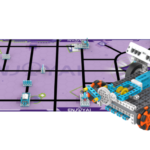
Inspired by inventions such as the compass, paper-making, gunpowder, printing, and great architectural wonders, participants complete missions that simulate real engineering problem-solving using technology.
This challenge combines creativity, engineering, and strategy in a competitive autonomous robotics environment designed to develop future-ready skills.
What You Will Do
- Design and build a fully autonomous competition robot
- Program line-following and task-based movements
- Navigate a structured field using guide lines
- Interact with mechanical models to complete scoring tasks
- Complete missions such as placing, triggering, or moving objects into scoring zones
- Return to base for retries or strategic resets
How Scoring Works
Teams earn points by completing historical-themed robotics tasks accurately and efficiently during each match:
- Compass: rotate pointer to correct position (50 points)
- Paper Making: move paper to lower board (60 points)
- Gunpowder: land cannonball in target zone (40 points)
- Movable-Type Printing: place blocks correctly (40 points each)
- Seismoscope: guide steel ball into frame (40 points)
- Pyramid: place correctly on second platform (60 points)
- Great Wall: place material on top correctly (60 points)
- Bonus task: up to 100 points (if included)
- Extra reward for fewer retries and smooth operation
Final rankings are based on total accumulated points across all rounds.
Game Strategy
Success in this competition requires more than just building a robot. Teams must think strategically and adapt quickly during matches.
- Efficient robot design within strict size and motor limits
- Reliable line-following and sensor accuracy
- Precise interaction with mechanical models
- Strong autonomous programming logic
- Time management across multiple missions
Robot Requirements
- Maximum size: 30 × 30 × 30 cm (before leaving base)
- Must be built using plastic snap-fit building parts only
- Maximum 4 motors (no servos allowed)
- Powered by a single internal battery (≤9V)
- No glue, tape, screws, zip ties, or rubber bands
- Fully autonomous after start signal
Competition Format
Each match lasts 150 seconds. Teams complete multiple autonomous runs on a historical invention-themed field.
All scores across rounds are combined to determine final rankings. Teams are ranked by total points, then time, then number of retries.
Road to China
Top-performing teams from the Caribbean competition may qualify for the international finals in China.
This program gives students from Curaçao and the Caribbean access to global opportunities in robotics, engineering, and AI.
Why Join
- Learn robotics, programming, and engineering skills
- Develop problem-solving and logical thinking
- Gain real autonomous robotics competition experience
- Compete for international qualification opportunities

Competition Details
* Participation fee only — robot not included.
Everything participants need to fully prepare for the competition, including educational material, resources, and official rules.
Competition Video
Competition Details
* Participation fee only — robot not included.
Everything participants need to fully prepare for the competition, including educational material, resources, and official rules.
Competition Video
About This Challenge
In Inventions Trail 2026, students explore the innovations that shaped human history through robotics.
Inspired by inventions such as the compass, paper-making, gunpowder, printing, and great architectural wonders, participants complete missions that simulate real engineering problem-solving using technology.
This challenge combines creativity, engineering, and strategy in a competitive autonomous robotics environment designed to develop future-ready skills.
What You Will Do
- Design and build a fully autonomous competition robot
- Program line-following and task-based movements
- Navigate a structured field using guide lines
- Interact with mechanical models to complete scoring tasks
- Complete missions such as placing, triggering, or moving objects into scoring zones
- Return to base for retries or strategic resets
How Scoring Works
Teams earn points by completing historical-themed robotics tasks accurately and efficiently during each match:
- Compass: rotate pointer to correct position (50 points)
- Paper Making: move paper to lower board (60 points)
- Gunpowder: land cannonball in target zone (40 points)
- Movable-Type Printing: place blocks correctly (40 points each)
- Seismoscope: guide steel ball into frame (40 points)
- Pyramid: place correctly on second platform (60 points)
- Great Wall: place material on top correctly (60 points)
- Bonus task: up to 100 points (if included)
- Extra reward for fewer retries and smooth operation
Final rankings are based on total accumulated points across all rounds.
Game Strategy
Success in this competition requires more than just building a robot. Teams must think strategically and adapt quickly during matches.
- Efficient robot design within strict size and motor limits
- Reliable line-following and sensor accuracy
- Precise interaction with mechanical models
- Strong autonomous programming logic
- Time management across multiple missions
Robot Requirements
- Maximum size: 30 × 30 × 30 cm (before leaving base)
- Must be built using plastic snap-fit building parts only
- Maximum 4 motors (no servos allowed)
- Powered by a single internal battery (≤9V)
- No glue, tape, screws, zip ties, or rubber bands
- Fully autonomous after start signal
Competition Format
Each match lasts 150 seconds. Teams complete multiple autonomous runs on a historical invention-themed field.
All scores across rounds are combined to determine final rankings. Teams are ranked by total points, then time, then number of retries.
Road to China
Top-performing teams from the Caribbean competition may qualify for the international finals in China.
This program gives students from Curaçao and the Caribbean access to global opportunities in robotics, engineering, and AI.
Why Join
- Learn robotics, programming, and engineering skills
- Develop problem-solving and logical thinking
- Gain real autonomous robotics competition experience
- Compete for international qualification opportunities